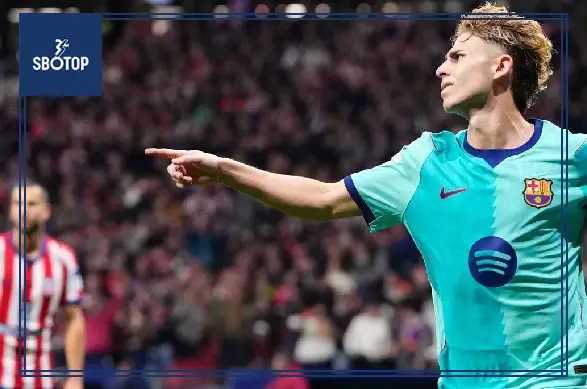
Barcelona’s recent triumph over Atletico Madrid with a scoreline of 2-1 in La Liga was more than just a showcase of individual brilliance. Coach Hansi Flick played a pivotal role in this match by demonstrating his courage to change tactics when his team struggled to take control of the game.
In the first half, Barcelona appeared less convincing on the road. Atletico pressed aggressively, disrupting the opponent’s midfield structure and consistently exploiting gaps around the visitors’ defense. The equalizer from Fermin Lopez just before halftime indeed provided Barcelona with a much-needed boost. Nevertheless, Flick recognized that his team needed a more significant shift, particularly to manage Atletico’s pressure and regain control of the match.
An Analysis of Atletico’s Dominance in the First Half
During the initial 45 minutes, Atletico Madrid effectively made it difficult for Barcelona to get into their rhythm through persistent pressing and efficient ball possession. Key players Pablo Barrios and Koke played crucial roles in limiting the movement of Barcelona’s Marc Bernal and Pedri in midfield. As a result, Barcelona lost grip on central areas of the field.
Additionally, Alex Baena and Giuliano Simeone capitalized on space around the visitors’ defense, creating dangerous attacking opportunities. This struggle was evident not only in possession but also in Barcelona’s inability to apply effective pressure, allowing Atletico to transition smoothly into their offensive plays. After the match, Flick acknowledged these weaknesses, stating, “In the first half, we were too far from our opponents and couldn’t press effectively. However, matches last for 90 minutes; the first half wasn’t perfect, but the second half was much better.”
The match also saw Barcelona’s trio of Cubarsi, Lamine Yamal, and Rodri achieve recognition by being included in the FIFPro World 11 for 2026. Furthermore, Pau Cubarsi was awarded the coveted Golden Boy for the same year, underscoring Barcelona’s commitment to nurturing young talent.
Frenkie de Jong’s Tactical Repositioning
One of the most intriguing decisions made by Flick came at halftime, where he substituted in Frenkie de Jong for Brian Farinas, placing the Dutch midfielder in an unconventional right-back position. This was a surprising choice given De Jong’s reputation as a playmaker in central midfield. Instead of opting for the more conventional Eric Garcia, Flick embraced a different strategy to counter Atletico’s pressure.
In his new role, De Jong did not merely fulfill the duties of a traditional right-back. His positioning provided Barcelona with additional passing options in central areas, while also maintaining composure when building attacks and navigating through the opponent’s pressure. His involvement on the right side, in tandem with Lamine Yamal and Fermin Lopez, energized Barcelona’s play and facilitated a better progression of the ball into Atletico’s defensive organization.
This tactical adjustment had a noticeable impact on Pedri’s performance as well. The young Spaniard began to exert a greater influence on the ball, allowing attacking players the opportunity to exploit spaces between Atletico’s midfield and defense. This synergy between the players ultimately led to Barcelona’s winning goal.
Statistics after the match highlighted this shift: Barcelona recorded 63% possession and took 19 shots, while Atletico managed only 37% possession with nine attempts. These figures, while not exclusively attributing Barcelona’s resurgence to De Jong’s positional change, reflect the visitors’ ability to seize control after the half-time interval.
Furthermore, Pau Cubarsi opted not to comment on Barcelona’s distance from Real Madrid in the standings, choosing instead to focus on team performance. Flick later revealed the sacrifices made by De Jong in the victory over Atletico Madrid, highlighting the midfielder’s dedication to adjust his play for the benefit of the team.
Flick continued to refine his strategy even after Barcelona took the lead, contemplating methods to defend their advantage without compromising the team’s ability to maintain ball control. At minute 60, Andreas Christensen replaced Joao Cancelo to fortify defensive options. A few minutes later, Eric Garcia came on for Bernal, who had received a yellow card. This substitution allowed De Jong to revert to his natural midfield position while Eric satisfied the duties at right-back.
With the defensive lineup now consisting of Eric Garcia, Pau Cubarsi, Christensen, and Gerard Martin, Barcelona completed the match with a solid structure. While Flick may not have perfectly defined his startup approach, his ability to recognize team weaknesses and make in-game corrections was a decisive factor in securing the victory at the Metropolitano Stadium.
ALSO READ :